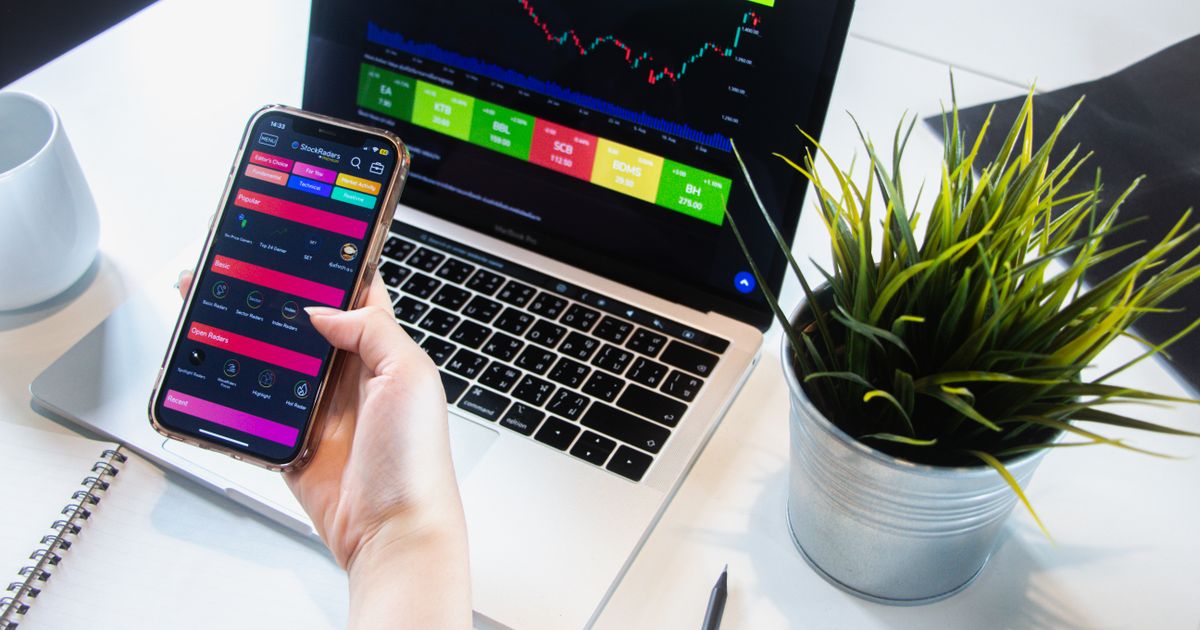
Photo by StockRadars Co. on Pexels
Trading Apps: Why the Alert Comes After the Move
Quick Answer
Trading apps notify you after a price threshold has already been crossed, because retail alerts and indicators are calculated from completed price data, not from the order flow that caused the move. The app is not broken and neither is your reaction time. It was simply never built to show you the thing that happens before price prints — only the thing that happened after.
My phone buzzes about GBP/USD more than it buzzes about my own family group chat, and lately the group chat is winning. (That should tell you something about my priorities, not just my trading apps.) If you have ever tapped into a trade the second an alert lit up your screen and watched price reverse before your thumb left the glass, you already know the feeling this post is about. Trading apps promise to put institutional-grade tools in your pocket. What they actually put in your pocket is a very fast way to react to something that already happened.
This post covers what a trading app genuinely shows you, why the alert always seems to arrive a beat too late, and what the professionals see that your phone was never licensed to display. If you came here hoping I would recommend a faster app, I would rather correct that now than seven sections in.
The alert came, you tapped in, and price had already turned
Here is a version of this most traders have lived through. The app buzzed, the built-in indicator flashed the setup you had been trained to look for, confluence ticked every box on the checklist, and you pulled the trigger with real confidence. By the time the order filled, price had already turned. My analysis was right and I still lost, except this time the analysis was not even yours — it was the app's, delivered on a two-second delay dressed up as real time.
The instinct afterward is to blame the broker, the app, or your own reflexes for being a fraction too slow. Almost none of that is what actually happened. You were not too slow. You were told a story about instant information that was never quite true.
It is not the app's fault, and it is not yours either
This is the part worth sitting with, because it changes how you read every red trade that followed one of these alerts. A trading app is not lying to you. It is doing exactly what it was designed to do — report on price action after it happens, as fast as the retail data licence allows. The gap between that and what you assumed it was doing, an early warning system, is a design choice you were never told about, not a personal failing.
Sure, heard that excuse before — every industry blames the tool eventually. Fair scepticism. But this one holds up structurally, and it matters, because a trader who blames their own reaction time for a structurally late signal spends years trying to get faster at a race that was decided before the starting gun.

Photo by Leeloo The First on Pexels
What a trading app actually shows you, and what it cannot
Strip away the branding and every mobile trading app is running the same basic pipeline: a retail price feed, a charting engine, and a set of fx tools built from that price feed. It is genuinely good at some things.
- →Live price action — accurate, fast, and clean, which is exactly what it is licensed and built to deliver.
- →One-tap execution — it has never been easier to pull the trigger, for better and for worse.
- →Built-in indicators — moving averages, RSI, and similar tools, all calculated from candles that have already closed.
- →Push alerts — a threshold crossed, reported the moment it is crossed, never before.
None of that is context. None of it explains why price arrived at that level in the first place, why a level held three times before breaking on the fourth, or whose orders were actually behind the move. That is not a missing feature the next update will fix. It is upstream of what any retail app is built to show, and it is the entire reason two traders can stare at the same chart and reach opposite, equally confident conclusions.
Why the notification always arrives after the move
(My apprentice set up eleven price alerts on his phone in one afternoon, convinced he had finally built himself an early warning system. I asked him what happens the moment the eleventh one fires. He went quiet. That is the whole problem in one silence.)
An alert can only exist after the condition it is watching for has been met. Price has to actually cross the level, the candle has to actually close, the indicator has to actually calculate its new value — all of that happens first, and the notification is simply the app telling you, after the fact, that it did. This is not a bug in your app. It is retail tools reacting exactly at the point where the price move that triggered them is already finished, the same mechanic that gets a stop hunted to the pip right before a genuine reversal.
The market is not chaotic here, and it is not rigged against you either. It has a repeatable structure — the alert genuinely does what it says, every time, on a fixed and predictable lag. The trap is not the tool malfunctioning. It is a trader believing the notification was ever going to arrive early enough to matter.

Photo by AlphaTradeZone on Pexels
What institutions see that the app was never built to show
Institutional desks are not staring at a phone waiting for a push notification. They are reading order flow — the actual buying and selling pressure building at a price level — and watching where liquidity is genuinely resting before price gets there, not after. The well-documented research on attention-driven buying found that individual investors are consistently net buyers of whatever grabbed their attention that day — news, a spike, an alert — while institutional investors show far less of that pattern. That is not because institutions have better willpower. It is because they are not working from a feed built to grab attention in the first place.
This is not a secret list or an insider feed you are locked out of by conspiracy. It is order block behaviour left in the chart by the size of institutional positioning, readable by anyone who learns to look for footprints instead of waiting for a buzz on their phone. The app was never going to teach you that, because reading footprints is not a feature you can put behind a push notification.
When a trading app is not the problem, and when it is
To be clear, I am not telling you to delete your trading app or hunt for a mythical better one. Switching from one day trading platform to another day trading app rearranges the furniture. It does not add the order flow context that was missing in the first place, and no amount of app-shopping fixes that. If your instinct after reading this is to go looking for a trade app with faster alerts, you have understood the mechanics and missed the point.
I can find this on YouTube for free, and honestly, you probably can find someone explaining fx tools and indicator settings for free right now. What is harder to find for free is someone telling you plainly that the notification you have been trusting was never designed to arrive early enough to matter. Constant alerts feeding FOMO into every session is how overtrading quietly becomes a habit rather than a decision, and no app setting turns that off for you. The FCA's own research on trading app design found that frequent push notifications push people toward riskier trades with higher leverage and larger position sizes, with the biggest impact on newer traders. That is not a coincidence built by accident.
If you are only trading because the buzz on your phone made the decision feel urgent, that is worth noticing before your next session, not after it. The risk management that actually protects an account rarely gets decided in the two seconds after a push notification.
Frequently asked questions
What is a trading app?
A trading app is mobile software that lets you view live prices, place orders, and manage an account from a phone, usually built on top of a broker platform. Most also include push alerts, basic charting, and a handful of pre-built indicators designed to make trading feel accessible rather than to give you a genuine market edge.
Do trading apps show real institutional order flow?
No. Retail trading apps display completed price and volume data, not the underlying order flow that caused it. Institutional order flow, the actual buying and selling pressure building before price moves, is not part of the retail data feed any app on your phone is licensed to show you.
Are trading app alerts reliable for entries?
Trading app alerts are reliable at reporting that a price level has already been crossed, which is different from being reliable for entries. Because the alert can only fire after the threshold is hit, by definition the move that triggered it has already happened, often milliseconds to seconds before the notification reaches your screen.
What is the best day trading app for beginners?
There is no single best day trading app, because the feature that actually matters, understanding why price is at a given level, is not something any app interface teaches. A clean, low-latency day trading app with a stable connection is a reasonable baseline. Beyond that, the app you pick changes very little compared to the context you bring to it.
Can a mobile trading app replace a desktop day trading platform?
For monitoring positions and reacting to news, a mobile trading app is usually enough. For serious analysis, a desktop day trading platform still tends to offer deeper charting and order tools. Neither format changes the core limitation: both show you price after the move that created it, not the order flow behind it.
Do the built-in fx tools and indicators in trading apps actually work?
Built-in fx tools and indicators are mathematically accurate calculations of past price, which is not the same as predictive insight. Moving averages, RSI, and similar indicators lag by design because they are derived from completed candles. They can describe what already happened clearly. They cannot show you what is building before it prints.
Should I switch to a different trade app if I keep losing?
Usually not. Switching a trade app changes the interface, not the information you are working with. If losses are coming from entering on alerts after the move has already happened, a different app with the same retail data feed and the same lagging indicators will produce the same result under a different logo.
Marco Stavros has traded forex from London since 2009. He has been through more trading apps than he can name, uninstalled most of them, and kept precisely none for the reason the marketing promised. His apprentice still has eleven alerts running. Marco has made his peace with it. Learn more about Marco.
Start Seeing What's Really Moving Price
Most traders react to price. Learn to read what drives it.
See how Rethink Forex works