
Photo by Atlantic Ambience on Pexels
Forex Scalping: What It Is, Why Most Fail, and Who It Suits
Published June 27, 2026 · Last updated June 27, 2026
Forex scalping is the trading equivalent of trying to win at poker by playing every hand, fast, with sunglasses on. The idea is seductive. The spread arithmetic is not. Scalping attracts more retail traders than any other style and produces worse results than any other style — not because the traders are undisciplined, but because the structural conditions for retail scalping are quietly catastrophic before the first trade opens.
This is not a guide that will teach you five scalping strategies and send you to the 1-minute chart. There are plenty of those. This one covers what the broker-written guides cannot afford to say: why the spread alone disqualifies most retail scalping approaches before they begin, what the professional version actually looks like, and — as important — who should not be scalping at all.
If you've tried several trading styles and scalping keeps drawing you back, the reason is usually one of two things: you like the idea of constant activity, or you've been told it's the fastest path to consistent profits. Both of those things are true. Both of those things are also problems.
The Short Answer
Forex scalping means opening and closing multiple positions within a single session, targeting 5–20 pips per trade at high frequency. It can be profitable — but not for most retail traders. The core problem is spread cost: on a 5-pip target with a 1.5-pip retail spread, 30% of potential profit is gone before price moves a single pip in your favour. Compounded over 40+ trades per session, that arithmetic is very difficult to overcome. Professional scalpers operate with interbank-level spreads far below what retail brokers offer. The approach is viable. The retail version of it, usually, is not.
What scalping actually involves
Scalping in forex means taking many small positions within a single session, holding each one for seconds to a few minutes, and targeting very small profits — typically 5–20 pips per trade. The theory is straightforward: if you can win more often than you lose, and do it repeatedly across 20–100 trades per day, the profits accumulate. It is the trading equivalent of a convenience store: thin margin per transaction, compensated by volume.
A scalper typically works from the 1-minute or 5-minute chart. Decisions happen fast — entry, stop, target, exit. There is no time for extended deliberation. A trade that needs thinking about has already moved. This pace is what attracts traders who find the daily chart too slow, and it is exactly what makes scalping psychologically brutal. Forty decisions per session is exhausting in a way that five decisions per session is not. The pull the trigger problem that affects all traders is compounded when the next trade is arriving every three minutes.
Scalping differs from day trading primarily in frequency and target size. A day trader might take three to ten positions per session with targets of 20–60 pips. A scalper takes 20–100 positions with targets of 5–15 pips. Both close all positions before the session ends. The practical difference is that the scalper's smaller targets make the spread cost a far more significant variable — and that one variable is where most retail scalping approaches break down.
The spread arithmetic that kills most retail scalpers
The spread is the cost you pay every time you open a CFD or forex position. On EUR/USD, a typical retail broker spread is 1.2–2 pips. It is charged the moment the trade opens, before price has moved a pip in your favour. For longer-timeframe traders targeting 40–100 pips, a 1.5-pip spread is a small friction cost. For scalpers targeting 5 pips, it is a 30% tax on every winning trade. (The spread, it turns out, doesn't offer volume discounts.)
The arithmetic is worth doing explicitly, because most scalping guides skip it:
EUR/USD, 1.5-pip spread, 100 trades, 60% win rate:
5-pip target, 2.5-pip stop (2:1 RR)
Net win per trade: 5 pips − 1.5 pip spread = 3.5 pips
Net loss per trade: 2.5 pips + 1.5 pip spread = 4 pips
Expectancy: (60 × 3.5) − (40 × 4) = 210 − 160 = +50 pips
Looks profitable. Now add the reality:
Spread widens during news events — common on 1-min chart — to 3–5 pips.
Win rate on live account (with hesitation, tilt, and slippage): drops to 52%.
Expectancy: (52 × 3.5) − (48 × 4) = 182 − 192 = −10 pips per 100 trades
The gap between demo performance and live performance is widest in scalping precisely because small target sizes make every pip of spread drag, hesitation, and slippage count. On a 100-pip daily chart trade, a 2-pip entry slippage is 2%. On a 5-pip scalping target, it is 40%. The same imprecision that costs nothing on the daily chart is catastrophic on the 1-minute chart.
Professional scalpers — institutional desks, high-frequency algorithmic systems — operate at near-zero spreads through direct market access. The approach that is viable with a 0.1-pip spread becomes structurally losing at a 1.5-pip retail spread. The strategy is the same. The economics are completely different.
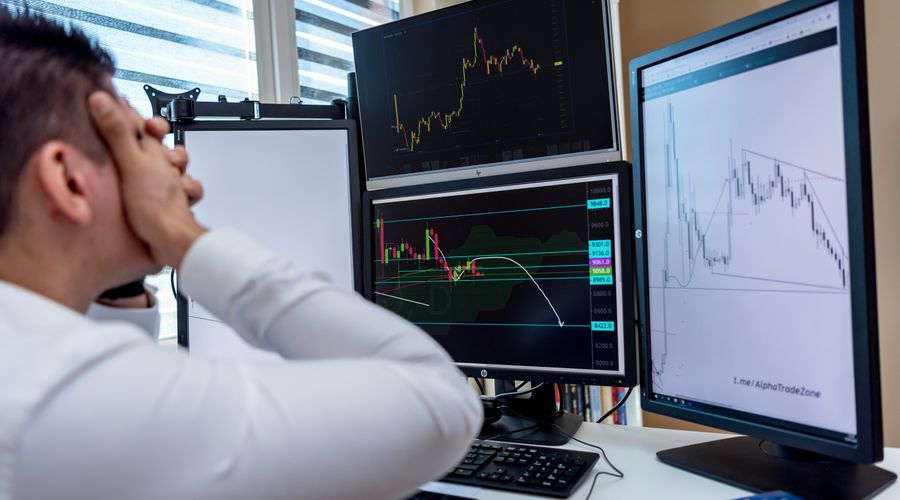
Photo by AlphaTradeZone on Pexels
Tight stops and the institutional sweep problem
Scalping requires tight stop losses. A 5-pip target with a 2:1 risk-to-reward means a 2.5-pip stop. A 10-pip target means a 5-pip stop. Those stops sit directly within the noise range of any active session — and they sit in locations that institutional order flow routinely sweeps through.
This is what retail scalpers describe as being stop hunted. The 1-minute chart during the London open or the New York session sees price sweep rapidly through small clusters of retail stops before reversing in the original direction. This is not a conspiracy — it is the normal behaviour of a liquid market processing large orders. Institutional buy orders in a rising market need available sell orders to fill against. The most efficient place to find those sell orders is where retail traders have their stop losses clustered.
A scalper with a 5-pip stop on the 1-minute chart will be stopped out by moves that a swing trader on the H4 chart would never notice. The same structural sweep that costs a scalper the trade costs a swing trader nothing — price barely registers on the H4 chart. The tight stop is not protecting the scalper. It is making the scalper the most efficient provider of liquidity in the market. (There is a reason institutional traders do not scalp at retail spreads with 5-pip stops.)
Understanding how institutional supply and demand zones work explains this. Institutional accumulation and distribution happen at specific price levels over time — not in seconds on a 1-minute chart. A scalper trying to read institutional intent from a 1-minute chart is asking the wrong timeframe the wrong question.
Why demo scalping works and live scalping doesn't
My apprentice once ran 40 scalping trades in a single demo session and came out with a −£15 result on a £5,000 account. He thought this was about even. It was not about even. It was 40 trades worth of spread cost showing up clearly even on a demo account with no emotional friction. On a live account — where hesitation delays entries, where three consecutive losses trigger revenge trading, where widened spreads during news events double the cost — that −£15 would have been considerably worse.
The demo-to-live gap is present in every trading style, but it is widest in scalping for a specific reason: small targets mean that every pip of friction — spread, hesitation, emotional exit — matters proportionally more. A swing trader who gets a 2-pip worse entry than planned on a 60-pip trade loses 3.3% of the target. A scalper who gets a 2-pip worse entry on a 5-pip trade loses 40% of the target.
The traders who tell you they can scalp profitably on YouTube are either showing you cherry-picked sessions, trading with institutional-level spreads not available on retail accounts, or running an account they can afford to bleed on slowly while recording the good days. If any of those apply to you, scalping remains a legitimate approach. For most people watching those videos, none of them do.

Photo by Rômulo Queiroz on Pexels
When scalping can work — and for whom
None of the above means scalping is impossible. It means scalping requires a specific set of conditions that most retail traders are not yet in position to meet. The conditions are:
- Access to tighter spreads. ECN brokers or DMA accounts offer significantly tighter spreads than standard market-maker accounts — often 0.1–0.5 pips on EUR/USD rather than 1.5–2 pips. This changes the spread arithmetic fundamentally. Scalping that is structurally losing at 2-pip spreads may be structurally viable at 0.3-pip spreads with a commission structure.
- Session timing discipline. Scalping during the London or New York session's first 30–60 minutes — when spreads are widening and volatility is highest — is when most stop hunts and spread spikes occur. Scalpers who operate during the overlap between sessions on high-liquidity pairs face more predictable conditions.
- A clear read on very short-term structure. Successful scalping uses the same structural logic as longer-timeframe trading — identifying the direction on the 15-minute chart, then entering pull-backs on the 1-minute chart within that bias. The entry is still a structural read; the timeframe is just compressed. Without the higher timeframe context, scalping is closer to guessing than trading.
- Psychological resilience at pace. Twenty losses in a row, each small, is more destabilising than one large loss for most traders. Scalping at pace means staying technically sound under conditions that consistently trigger on tilt behaviour in longer-timeframe traders. This is a skill. It takes time to develop.
The traders who scalp well have typically traded longer timeframes first and built a market read before compressing it to the 1-minute chart. The traders who begin on the 1-minute chart because they want fast results are usually the ones who describe scalping as “rinse and repeat — mostly rinse.”
Who should not be scalping
This is worth being direct about. You should not be scalping if:
- You are new to forex trading. The risk management fundamentals need to be instilled at a timeframe where you have time to think. A 1-minute chart does not give you time to think. Developing market instincts at pace, before developing them at all, is a reliable path to blown accounts.
- You are using a standard retail broker with 1.5+ pip spreads. The arithmetic simply does not support scalping at those spread levels for targets under 15 pips. This is not an opinion — it is the maths done above. You can try the calculation with your own spread, target, and win rate. The conclusion rarely changes.
- You have been on tilt recently. Scalping under emotional conditions is how traders move from small, manageable losses to accounts that need rebuilding. The pace removes the opportunity for the brief reset that longer timeframes naturally provide. One bad trade on the 1-minute chart is followed immediately by the opportunity for another bad trade.
- You cannot commit to session timing. Scalping during low-liquidity periods or around news releases — when spreads widen and price behaviour becomes erratic — removes whatever edge the approach has. Scalping is a session discipline problem before it is a strategy problem.
- You are looking for a shortcut to fast profits. Scalping produces fast results. Those results are not reliably profits at retail spreads. The appeal of constant activity is not the same as the structural advantage of a solid approach. Understanding what a chart is actually showing you matters on the 1-minute chart exactly as much as it does on the daily. It just matters faster.
Frequently asked questions
What is scalping in forex trading?
Forex scalping means opening and closing multiple positions within a single session — sometimes within seconds or minutes — targeting 5–20 pips per trade at high frequency. The core structural challenge is the spread: at a 1.5-pip retail spread and a 5-pip target, 30% of potential profit is gone before price moves a single pip in your favour. Professional scalpers use interbank spreads close to zero, which produces an entirely different arithmetic.
Is forex scalping profitable?
Scalping can be profitable but the conditions required are far more demanding than most guides acknowledge: near-zero spreads, a clear structural read on short-term price behaviour, and psychological stability under the pressure of 20–50+ decisions per session. Most retail scalpers fail because the spread alone consumes a prohibitive percentage of winning trade profit over a meaningful sample — particularly when live account hesitation reduces the win rate below the demo figure.
Why do most forex scalpers lose money?
Three structural reasons: (1) The spread cost is proportionally catastrophic on small targets — a 2-pip spread on a 5-pip target means 40% of potential profit is gone before the trade starts. (2) Tight stops on the 1-minute chart sit in locations that institutional order flow routinely sweeps through, triggering losses just before the expected move occurs. (3) Scalping demands 20–100+ decisions per session; emotional consistency under that pressure collapses faster than in longer-timeframe approaches.
What timeframe do scalpers use?
Most scalpers operate on the 1-minute (M1) and 5-minute (M5) charts. These very short timeframes create specific problems: price noise is significantly higher, spread costs represent a larger percentage of each move, and institutional order flow can sweep through 5–10 pips in seconds. Higher timeframe scalpers using the M15 or M30 chart have structurally better conditions but are often classified as day traders rather than scalpers.
What is the difference between scalping and day trading?
Scalping is a subset of day trading — both involve closing all positions within a single session. The distinction is in frequency and target size. Day traders typically execute 3–10 trades per session with targets of 20–60 pips. Scalpers execute 20–100 trades per session with targets of 5–15 pips. Day trading gives spread costs significantly less weight relative to targets, which is one structural reason it tends to be more viable for retail traders.
Can beginners scalp forex?
Forex scalping is one of the hardest approaches for a beginner to make work. It requires rapid decision-making under pressure, knowledge of how to avoid spread-widening events, and the psychological stability to make 20–50+ decisions per session without revenge trading. Beginners are better served developing market reading skills on the H4 or daily chart, where the structural signals are cleaner and there is time to think before each decision.
What pip target should a forex scalper aim for?
Most guides suggest 5–10 pip targets. The problem is the spread. On EUR/USD with a 1.5-pip retail spread, a 5-pip target means 30% of potential profit is already gone. A 10-pip target reduces that to 15% — still significant over a large sample. Professional scalpers with interbank access face 0.1-pip spreads on a 5-pip target: 2%, which is viable. The same approach at retail spreads produces a different result entirely.
Marco has traded forex from London since 2009. He tried scalping in 2011. The spread arithmetic took approximately three weeks to make itself clear. He now trades the H4 and daily chart, which has the significant advantage of not requiring him to stare at a 1-minute chart for six hours while questioning every decision at pace.
Start Seeing What's Really Moving Price
Most traders react to price. Learn to read what drives it.
See how Rethink Forex works